It’s the classic dilemma. You’re in San Diego, you know thousands of gray whales are cruising past our coastline, and you want to see one. But then the questions start creeping in. Will I get seasick? Is it worth spending $80 to stare at the ocean? Can I take my three-year-old on a boat without losing my mind?
I’ve been there. I’ve done the “hold onto the railing and pray” boat trip. I’ve also spent hours squinting at the horizon from a cliff with a cup of coffee in hand.
Here’s the good news: San Diego is one of the few places in the world where both options—land and sea—are actually viable. You don’t have to get on a boat to see a whale here. But if you do, the experience is completely different.
Let’s break down the pros, the cons, and the reality of both, so you can choose the adventure that fits your vibe (and your stomach).
Option A: Land-Based Whale Watching (The “Iron Stomach” Choice)
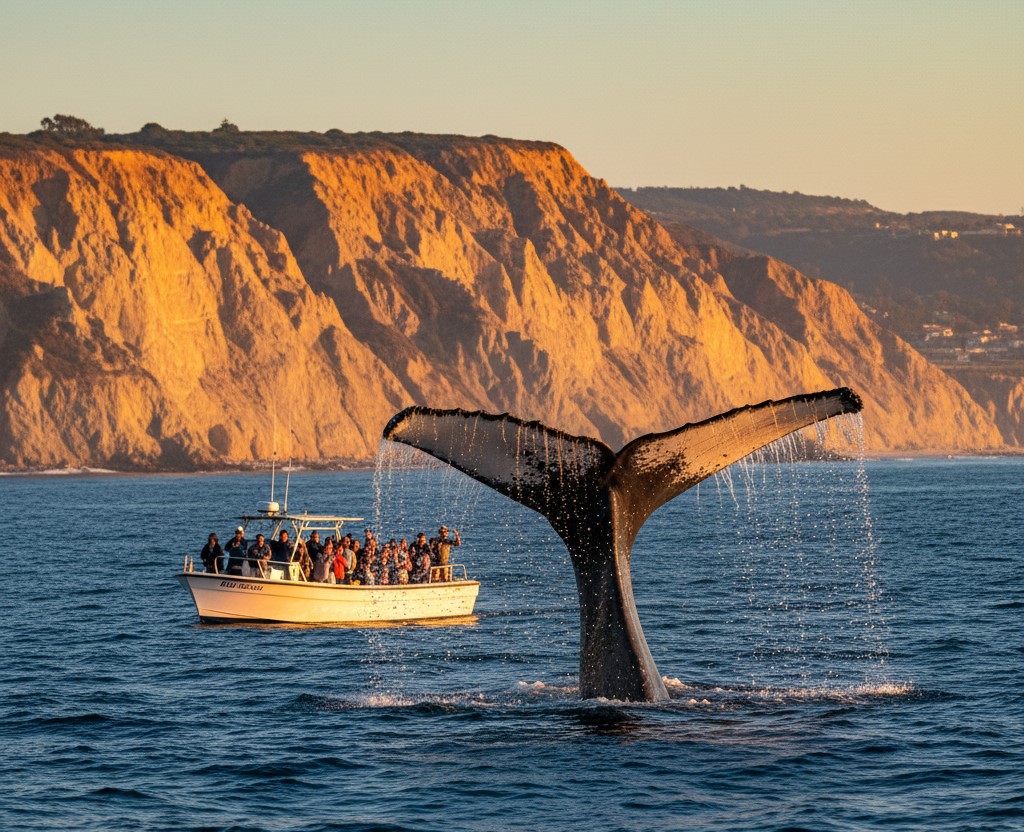
For travelers prone to seasickness or those on a budget, land-based whale watching at Cabrillo National Monument offers the best vantage point in Southern California. Located 400 feet above sea level on the Point Loma peninsula, this spot provides panoramic views of the migration corridor, allowing visitors to spot spouts and breaches without leaving solid ground.
There is something incredibly peaceful about watching whales from land. No diesel fumes. No rocking deck. Just you, the wind, and the Pacific Ocean.
Cabrillo National Monument: The King of Lookout Points
If you’re going to do this from shore, Cabrillo is the place. It’s not just a park; it’s geographically perfect. The peninsula sticks three miles out into the ocean, forcing the whales to swim right around the tip.
I remember one Tuesday morning in late January. I drove up to the Whale Watch Lookout Point, set up my camping chair, and just waited. The park rangers had written “14 Whales Sighted Today” on the whiteboard. Fourteen!
And sure enough, about twenty minutes in—poof. A white puff of mist against the blue water. Then another. I watched a pair of gray whales navigate the kelp beds for half an hour.
The catch? Distance. Even with the naked eye, the whales look like logs floating in the water. You see the splash, you see the blow, but you aren’t going to look a whale in the eye. You need binoculars. Seriously, don’t go without them. The park has those coin-operated viewers, but bring your own if you can.
Torrey Pines & Sunset Cliffs: The “Wild” Alternatives
If paying the entrance fee at Cabrillo isn’t your thing, Torrey Pines State Reserve is my favorite backup. You have to hike a bit to get to the cliff edge, but the elevation is fantastic. Plus, you’re surrounded by those rare Torrey pine trees. It feels wilder.
I’ve also had luck at Sunset Cliffs in Ocean Beach. It’s lower elevation, so your view isn’t as wide, but it’s completely free. Grab a burrito, sit on the sandstone cliffs, and scan the horizon. Just don’t expect a National Geographic moment; expect a “Hey, I think that was a whale!” moment.
Option B: Boat Tours (The Immersive Experience)
Boat tours provide the closest possible encounters, allowing passengers to hear the whales breathe and observe behaviors like spy-hopping and fluking up close. San Diego operators offer three main vessel types: stable catamarans for families, high-speed RIBs (Zodiacs) for thrill-seekers, and sailboats for a quiet, eco-friendly approach.
Okay, land is safe. But being on the water? That’s where the magic happens. That’s where you feel the scale of these animals. But not all boats are created equal. I learned this the hard way.
The “Navy SEAL” Style: RIBs (Rigid Inflatable Boats)
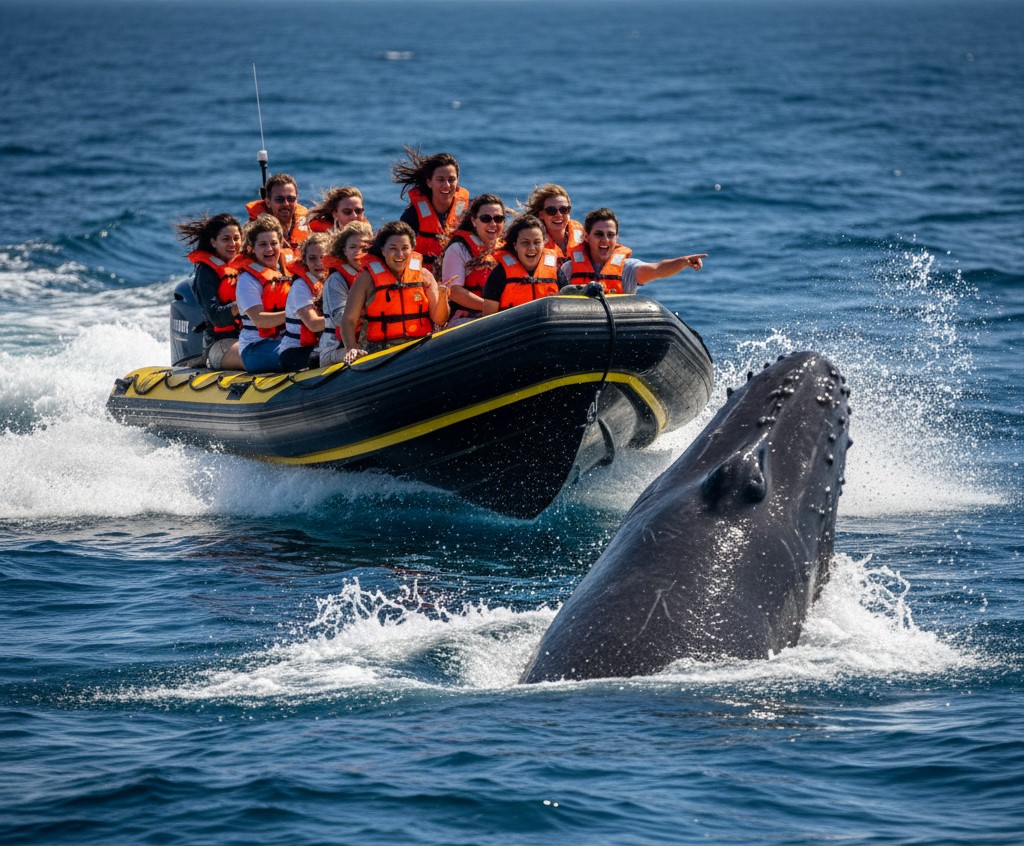
These are the small, fast, low-to-the-water rafts. They hold maybe 12 people. You sit on the side tubes, holding onto a rope.
The vibe: Pure adrenaline. You are fast. If a captain spots a whale three miles away, you’re there in ten minutes. And because you’re so low, when a whale surfaces near you, it feels massive. I was on a RIB once when a gray whale exhaled, and the mist drifted right over us. It smelled like… well, like fishy broccoli. But it was incredible.
The reality check: There is no bathroom. Let me repeat that: No. Bathroom. And if the ocean is choppy, you will feel every single bump. It’s a spine-compressing ride. If you have back issues or are pregnant, skip this. Seriously.
The “Floating Living Room”: Large Yachts & Catamarans
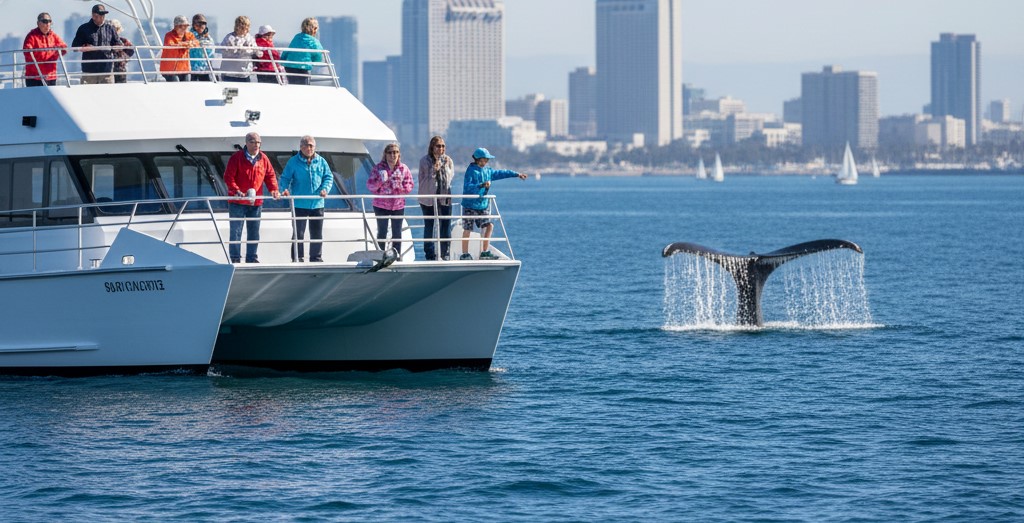
This is the standard “whale watching cruise.” Double-decker boats, snack bars, indoor seating, restrooms.
The vibe: Relaxed. You can wander around with a beer or a hot chocolate. The captains are usually on a loudspeaker giving a narrated tour.
Why pick this: Stability. These boats handle the swell much better. If you’re worried about getting sick but still want to go out, pick a catamaran (two hulls). They don’t roll side-to-side as much as single-hull boats.
The downside: Crowds. When a whale pops up, 100 people rush to that side of the railing. It can feel a bit like a paparazzi scrum. My tip? Stay on the lower deck at the bow (front). Everyone runs to the top deck, but the lower deck gets you closer to the water level.
The “Silent Hunter”: Sailboats
This is the niche option, but man, is it underrated. Some operators use historic schooners or modern sailing yachts.
The vibe: Zen. No engine noise. Just the wind and the water.
The magic moment: Because the boat is quiet, the whales sometimes come closer. They aren’t spooked by engine vibrations. Hearing the whoosh of a whale’s breath in total silence is something you never forget.
Decision Guide: Who Are You?
Let’s cut through the noise. Here is exactly which option you should book based on your specific situation.
The Family with Toddlers
Go with: The Large Catamaran or Cabrillo National Monument.
Don’t put a 3-year-old on a Zodiac. Just don’t. You need a bathroom, you need shade, and you need the option to go inside if they get bored (and they might). The large boats often have “Junior Ranger” books or coloring sheets, too.
The Photographer / Adventure Seeker
Go with: The RIB (Zodiac).
You want that low angle. You want the shot where the whale looks like a mountain rising out of the water. You can’t get that looking down from a yacht deck. Plus, the speed means you might see 3-4 different groups of whales in one trip.
The “I Get Carsick in a Parking Lot” Traveler
Go with: Cabrillo National Monument.
Don’t be a hero. I’ve seen miserable people on boats, green in the face, praying for death while a majestic whale breaches 50 feet away. They didn’t care. If you are sensitive, stay on land. You’ll actually enjoy it.
The Romantic Date
Go with: The Sunset Sailboat.
Pack a jacket, bring sunglasses. It’s intimate, it’s beautiful, and even if you don’t see a whale, you had a lovely sail off San Diego. Win-win.
Practical Tips for Any Choice
If you choose the boat (and you’re prone to motion sickness), take your Dramamine the night before and then again in the morning. Seriously. It needs time to get into your system. Once you feel sick, it’s too late.
And for the land-lubbers: Go in the morning. The “marine layer” (coastal clouds) usually burns off by noon, but the wind picks up in the afternoon. Late morning—say, 10 AM to 12 PM—is the sweet spot for calm water and good visibility.
Whether you’re gripping the railing of a speeding raft or leaning against a sandstone cliff, seeing a gray whale is a privilege. It’s a reminder that we share this coast with giants. So pick your mode of transport, grab your binoculars, and go say hello.